Platform & Architecture
Engineered to sit on top of what you have.
Interpose takes no custody. Both experiences — wealth management and self-directed — run over the custody you already hold, through one gateway, event-sourced, API-first and auditable end to end. Whether you're an advisory firm unifying three custodians or a brokerage platform adding an advisory layer, this is the same architecture.
Design Principles
Engineered like infrastructure, not an app.
API-first
Every capability is a REST endpoint before any UI exists, with event streams alongside it. OpenAPI 3.1 is the source of truth — generate a client in any language.
Event-sourced
Positions are always derived from an immutable transaction ledger — never overwritten. Every state change emits a CloudEvent, giving you a complete, replayable audit trail.
BaaS-gateway model
The PM layer never connects to a custodian directly. All custody protocols — FIX, REST, SFTP, CSV — terminate at the BaaS gateway, so there is one integration surface, not N.
Cloud-native & modular
Stateless, horizontally-scalable services with clean interface contracts. Take the PM layer, the investing app, or both — no hidden coupling forces an all-or-nothing adoption.
The Gateway Model
One integration surface. Every custodian behind it.
Both front ends talk to a single gateway. The gateway owns every custody protocol — so adding a custodian never changes the PM layer, the portals, or the app.
Interpose Invest · white-labeled as your product
BaaS Gateway · single integration surface
Normalizes positions, transactions, and orders · owns FIX / REST / SFTP / CSV · routes rebalance orders to execution · enforces compliance checks
Your Native BaaS
you keep custody
Correspondent Custody
you keep custody
RIA Custodians
you keep custody
Crypto Custody
you keep custody
Interpose holds no assets. The broker-dealer or custodian of record is you or your custodian.
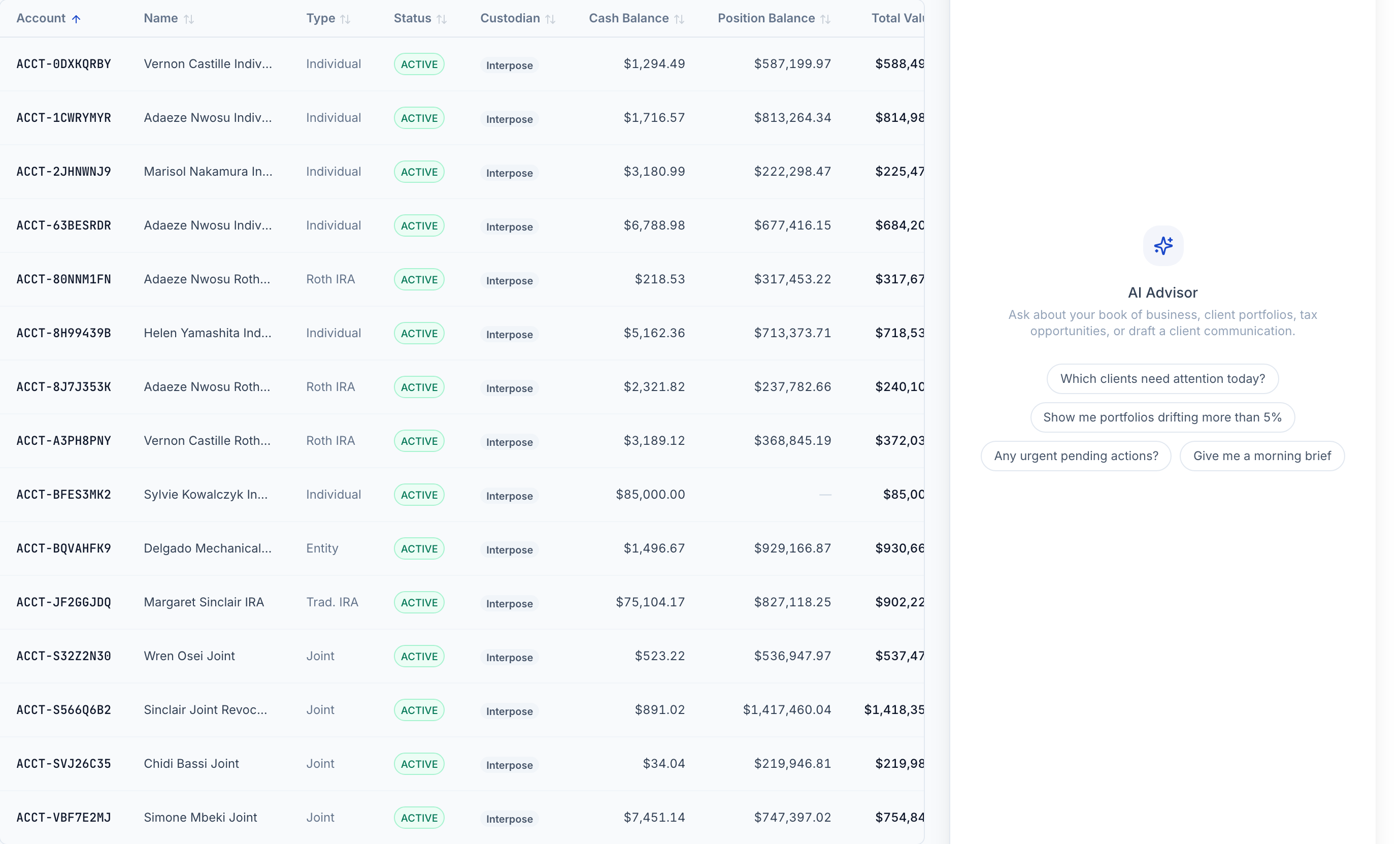
One Book Of Record
Every custodian, in one table, with the same columns.
Cash, positions, total value, cash weight, assigned portfolio and drift — computed the same way whoever holds the assets. The custodian is a column, not a separate system with its own reconciliation.
Latency is stated per connection rather than averaged away: an API custodian refreshes on demand, a file-delivered one is as fresh as its last drop.
Multi-Custodian Connectivity
Aggregate every custodian into one data model.
Register a connection per account and the gateway pulls positions and transactions into a single normalized view — no matter where the assets actually sit.
Ingestion modes
Order routing for every custodian flows back through the gateway's execution path — the PM layer emits proposed orders; the gateway handles the per-custodian protocol.
Canonical normalization
- Typed security identifiers — CUSIP, ISIN, ticker, or contract address — never a bare string
- Monetary amounts as 4-decimal strings; share quantities as 8-decimal strings — never floats
- Corporate-action timing quirks handled per custodian before data reaches your API
- Equities, funds, and alternatives resolved to one canonical position model
Custodian-agnostic by design: bring your own brokerage rails, correspondent custody, or the outside custodians your advisors already use. Crypto assets flow through qualified third-party custody only — Interpose never self-custodies.
Two Operating Modes
Identical capabilities. Honest latency.
Every capability is the same in both modes. We're explicit that overlay mode is bound by the custodian's feed cadence — no real-time claims we can't keep.
| Dimension | Real-timeIntegrated Mode | Feed-boundOverlay Mode |
|---|---|---|
| Position source | Shared event bus (CloudEvents) | Gateway pull from custodian |
| Update latency | Real-time | Feed-bound — typically T+1 |
| AUM & drift | Live on every fill | Refreshed on each sync |
| Rebalancing | Full engine | Full engine |
| Performance & billing | Full engine | Full engine |
| Order routing | Through gateway | Through gateway |
Real-Time Event Streams
Every state change is an event your systems can subscribe to.
In integrated mode, rebalances, fills and position changes are published as CloudEvents 1.0. The transport reachable from your own infrastructure today is Server-Sent Events over ordinary HTTP — no upgrade, no special client, and it survives the corporate proxies that block WebSockets.
Because positions are event-sourced, you can replay the full history of any account to reconstruct state at any point in time — the foundation for a clean audit and for reconciliation that catches breaks the moment they appear.
Compliance as Code
Regulatory rules that execute, not sit in a PDF.
Wash-sale windows, Reg-T, PDT, Reg SHO, and OFAC screening are versioned, tested policy — checked synchronously, with machine-readable rejection codes your systems can act on.
For Brokerage & Custody Platforms
You own the rails. You're missing the front end.
If you run custody, clearing or execution and your customers keep asking for portfolio management or a consumer investing app, this is the same platform approached from the other side.
You keep everything regulated
Custody, clearing, execution, the balance sheet, the customer contract and the broker-dealer licence stay with you. Interpose supplies software and takes no custody, so nothing about your regulatory posture changes.
Two front ends, one integration
An advisory stack for the RIAs and wealth firms on your rails, and a self-directed experience for the consumer channel — both white-labeled, both over a single custodian connection.
No front-end org to build
Portfolio management and a consumer investing app are each a multi-year build with a team attached. This is an integration and a partner engineer instead.
Sandbox first, contract later
The fastest route is a working integration against your sandbox before any commercial conversation. We would rather show you a running system than a deck.
See It For Yourself
Reading about it is the slow way.
Take a sandbox firm and click through the gateway model, the custodian view and the event stream on a seeded book. If you want the architecture walked through, ask — you get the person who designed it.